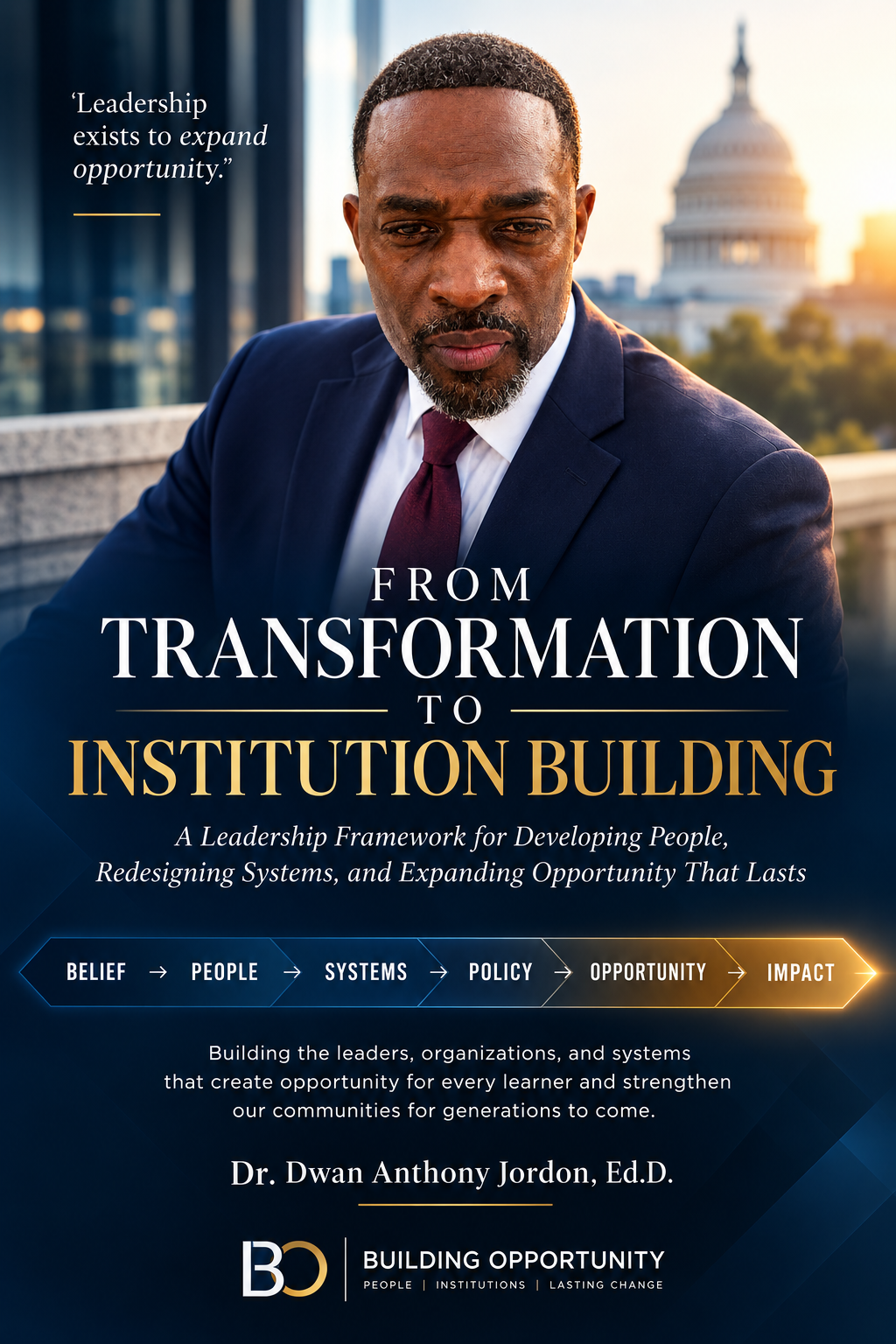
Building Opportunity Signature Paper
This paper distills the central argument of Building Opportunity: leadership is the intentional progression from belief to impact. It draws on nearly three decades of practice across school transformation, executive leadership, organizational redesign, specialized education, leadership development, and research, while extending the manuscript into an executive framework for leaders responsible for lasting change.
Why I Still Choose Hope
After nearly three decades in education, I have learned that meaningful results do not always produce corresponding opportunities. In this final chapter before the epilogue, I reflect on why I still choose hope—through historic school transformations, leaders developed, institutions strengthened, and doors that did not open. This is not a story about optimism. It is about disciplined hope: building a future that may not reward us personally but remains worth building.

Leadership Looks Around Corners
The purpose of foresight is not to be right about tomorrow. It is to prevent an organization from being helpless when tomorrow is different from today. Instead of asking, “What will happen?” leaders must ask, “What would we wish we had begun if this happened sooner than expected?” That question turns uncertainty into preparation. Leadership has never required certainty about the future. It requires stewardship before certainty arrives.
Leadership Begins With Understanding
The more I think about “leadership begins with understanding,” the more I see its consequences throughout history.
In education, when we saw low student achievement, we sometimes concluded that students needed more testing. When schools struggled, we sometimes assumed the school itself was the problem and closed it—without fully understanding poverty, neighborhood disinvestment, teacher turnover, resource inequities, or what the school meant to the community. When students were chronically absent, we often treated attendance as a compliance problem before asking what was happening in their lives. When teachers left, we called it a recruitment problem before asking what their experience inside the organization was telling us.
We can see the same pattern beyond education. During the crack-cocaine era, America responded heavily through criminalization before adequately confronting addiction, trauma, poverty, and the conditions surrounding drug use. In business, organizations have responded to declining performance by cutting people before examining whether strategy, leadership, culture, or the business model itself was failing. In communities, we have sometimes responded to violence primarily by asking how to punish it rather than also asking what conditions repeatedly produce it.
None of this means testing, accountability, school closure, enforcement, restructuring, or consequences are always wrong. That would simply replace one oversimplification with another.
The deeper lesson is this:
When we misdiagnose a problem, even a well-intended solution can create another problem.
That is why “Help me understand” is more than a leadership phrase to me. It is a discipline.
Before we ask, “What are we going to do about this?” perhaps leadership requires us to ask first:
“What are we actually looking at—and what are we still failing to understand?”

Leadership Under Public Scrutiny
Leadership becomes most revealing when we no longer control the story being told about us. Public scrutiny can challenge our decisions, question our motives, and reduce years of work to a single moment. Mature leadership requires us to listen carefully, own what belongs to us, correct what needs correcting, and resist allowing criticism to become our identity. We may not control every narrative, but we remain responsible for our character, our purpose, and the integrity with which we continue to serve. The real test is not whether everyone understands our leadership—it is whether we can remain faithful to who we are when they do not.
Leadership Requires Courage
Leadership is not tested when everyone agrees with us. It is tested when doing what is right requires us to accept discomfort, resistance, and sometimes criticism. Courageous leadership is not about being tough or fearless; it is about acting with conviction while remaining grounded in humility and humanity. The question that has stayed with me throughout my career is simple: Who will bear the cost if I choose not to act? In education, too often, that cost is quietly carried by children.

Leadership Expands Human Potential
Leadership Expands Human Potential challenges leaders to look beyond performance and consider a more enduring measure of impact: what becomes possible in people because of how we lead them. Drawing on lessons from nearly three decades of leadership, Dr. Dwan Jordon explores how belief, high expectations, intentional support, and accountability can help people move beyond the limitations others—or they themselves—have placed on their potential. Ultimately, the article argues that leadership is not simply about building stronger organizations; it is about developing more confident, capable, and courageous people who go on to expand opportunity for others.
The Executive's Work Is Institution Building
The Executive’s Work Is Institution Building explores how executive leadership extends beyond producing immediate results to building institutions that endure. Drawing from nearly three decades of leadership experience, Dr. Dwan Anthony Jordon examines how purpose, people, systems, culture, governance, partnerships, and learning create lasting institutional capacity. The chapter argues that the true measure of executive leadership is not only what improves while a leader is present, but what remains stronger after the leader is gone.
Policy Is the Architecture of Opportunity
In this sixth essay in the Building Opportunity series, I explore how policy serves as the architecture beneath opportunity. I argue that policy is far more than compliance, legislation, or organizational procedure. Every policy reflects a set of values, shapes organizational systems, and ultimately determines the experiences of the people those systems were created to serve.
Building Opportunity: Leadership Reflections for Executives | Chapter Five | Organizations Produce What They Are Designed To Produce
Why do some organizations consistently succeed while others struggle? This article explores a fundamental leadership principle: organizations produce what they are designed to produce. Sustainable improvement requires more than talented people—it requires leaders willing to redesign the systems that determine results.

Building Opportunity: Leadership Reflections for Executives | Chapter Four |Leadership Expands Opportunity
What is the ultimate purpose of leadership? This essay argues that leadership is not about managing organizations—it is about creating opportunities that transform lives, strengthen communities, and shape future generations.
Building Opportunity: Leadership Reflections for Executives | Chapter Three |Leadership is Stewardship
Leadership is more than achieving results—it is accepting responsibility for the people, systems, and opportunities entrusted to your care. This article explores why the most enduring leaders are remembered not for the positions they held, but for the futures they helped build.
Building Opportunity: Leadership Reflections for Executives | Chapter Two | Leadership That Multiplies
Leadership isn't measured by how many people follow you—it's measured by how many leaders emerge because of you. In this chapter of the Building Opportunity series, I explore why the greatest leaders don't create followers; they create the conditions for others to lead, grow, and multiply their impact.
Building Opportunity: Leadership Reflections for Executives | Chapter One | Leadership Begins with Belief
Every great leader begins with a simple but transformative choice: to believe in people before they have fully realized their own potential. This chapter explores why belief is not naïve optimism—it is a strategic leadership practice that inspires growth, builds confidence, and unlocks possibilities that others may not yet see.